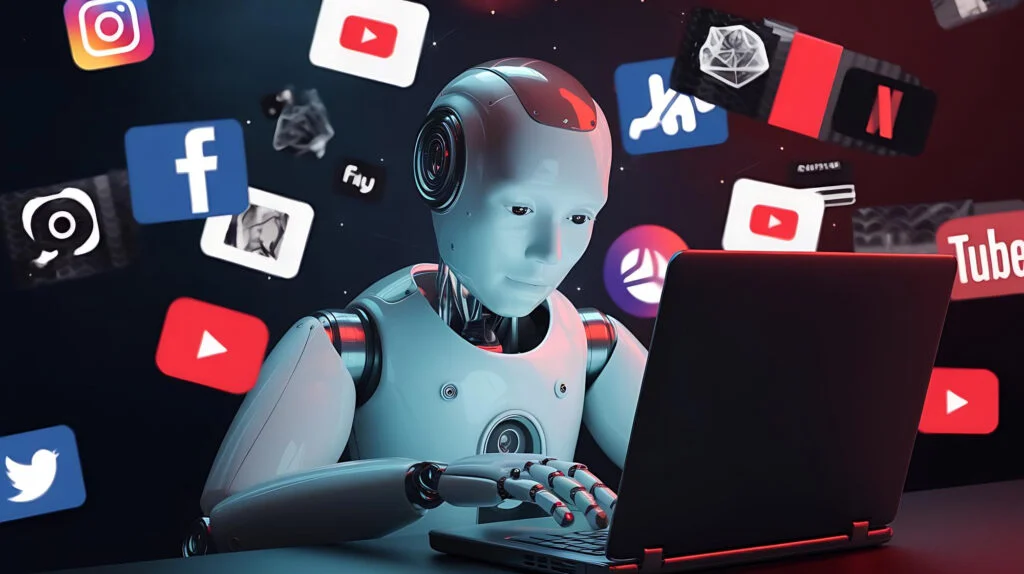
Social media marketing has changed significantly in recent years. Businesses are no longer competing only for attention—they are competing for relevance.
People expect brands to understand their interests, respond quickly, provide useful content, and create experiences that feel relevant rather than generic.
This is where AI-powered social media marketing is becoming increasingly useful.
Artificial intelligence can help marketers analyze audience behavior, identify patterns, create content, personalize messaging, automate repetitive tasks, and improve campaign performance.
But AI is not a replacement for marketing strategy.
The strongest results come when businesses combine AI with human creativity, customer understanding, brand knowledge, and continuous optimization.
What Is AI-Powered Social Media Marketing?
AI-powered social media marketing is the use of artificial intelligence to support activities such as audience research, content creation, personalization, advertising, performance analysis, and campaign optimization.
AI can help marketers process large amounts of information and identify patterns that may be difficult to spot manually.
For example, AI can support:
-
Audience segmentation
-
Content ideation
-
Social media copywriting
-
Creative variations
-
Ad optimization
-
Performance analysis
-
Trend identification
-
Customer personalization
-
Reporting and insights
-
Marketing automation
The purpose isn’t to automate every part of social media marketing.
The purpose is to help marketers make better decisions and execute efficiently while keeping the human element of marketing intact.
Why Is AI Changing Social Media Marketing?
Social media generates a significant amount of information about what audiences watch, click, share, comment on, and respond to.
Analyzing that information can help businesses understand what resonates with different audiences.
AI can make this process faster by identifying patterns and helping marketers turn data into actionable insights.
This creates opportunities to improve several areas of social media marketing.
1. Better Audience Targeting
Reaching the right audience is one of the biggest challenges in social media advertising.
AI can help marketers analyze audience characteristics and behavioral patterns to identify potentially valuable segments.
Instead of treating an entire audience as one group, businesses can develop more relevant campaigns for different customer segments.
For example, a business may create different messaging for:
-
First-time visitors
-
Previous website visitors
-
Existing customers
-
High-intent prospects
-
Different geographic markets
-
Different customer interests
Better segmentation can make campaigns more relevant and reduce the risk of showing the same message to everyone.
2. More Personalized Content
People are more likely to engage with content that feels relevant to them.
AI can help marketers create variations of content for different audiences, platforms, or stages of the customer journey.
This could include variations in:
-
Headlines
-
Ad copy
-
Offers
-
Calls to action
-
Creative concepts
-
Video scripts
-
Social captions
However, personalization should still reflect the brand’s voice.
AI-generated content should be reviewed and refined by people who understand the business, its customers, and its positioning.
3. Faster Content Creation
Creating social media content consistently takes time.
AI tools can help marketers speed up parts of the creative process, including:
-
Brainstorming content ideas
-
Creating initial copy drafts
-
Developing hooks
-
Repurposing existing content
-
Creating creative variations
-
Generating content outlines
-
Summarizing long-form material
This doesn’t mean every piece of content should be created entirely by AI.
The strongest workflow is often:
Human strategy → AI-assisted creation → Human review → Publishing → Performance analysis
This allows teams to work faster without sacrificing quality or brand authenticity.
4. Smarter Social Media Advertising
AI is also changing how businesses approach paid social campaigns.
Advertising platforms increasingly use machine learning to help with audience delivery, creative distribution, bidding, and optimization.
Marketers can support this process by providing:
-
Strong creative concepts
-
Clear campaign objectives
-
Accurate conversion tracking
-
Useful audience signals
-
Multiple creative variations
-
Reliable performance data
AI can help optimize delivery, but the campaign still needs a clear business objective.
More automation does not automatically mean better advertising.
5. Real-Time Performance Analysis
One of the biggest advantages of AI is its ability to process large amounts of information quickly.
Instead of manually reviewing every campaign metric, marketers can use AI-assisted analysis to identify patterns and potential issues.
For example, performance data may reveal:
-
A creative losing engagement
-
An audience segment outperforming others
-
Rising acquisition costs
-
A landing page receiving traffic but generating few conversions
-
A campaign producing clicks without meaningful business outcomes
These insights can help marketers decide what needs attention.
6. Better Customer Engagement
AI can also support customer communication.
Depending on the business and platform, AI-powered systems can help organize inquiries, identify common customer questions, assist with responses, and route conversations to the appropriate team.
However, automation should not eliminate the human side of customer communication.
Customers still value genuine responses, especially when questions involve complex purchases, complaints, or important decisions.
The best approach is to automate repetitive tasks while keeping humans involved where judgment and empathy matter.
7. Social Media Trend Analysis
Trends can change quickly on social platforms.
AI can help marketers analyze large volumes of content and identify emerging topics, themes, and audience interests.
This can help businesses discover potential content opportunities before they become outdated.
However, businesses should not chase every trend.
A trend only becomes valuable when it makes sense for the brand and its audience.
Relevance should come before reach.
AI Does Not Replace Marketing Strategy
This is one of the most important points businesses should understand.
AI can help you create more content.
It can help you analyze more data.
It can help automate repetitive tasks.
But it cannot replace the need to understand:
-
Who your customer is
-
What problem you solve
-
Why customers should choose you
-
What makes your brand different
-
Which channels matter most
-
What your business is trying to achieve
Without a clear strategy, AI can simply help a business produce more of the wrong things.
The goal isn’t:
More content.
The goal is:
Better marketing decisions.
How to Use AI Without Losing the Human Element
A practical AI-powered social media workflow can look like this:
Step 1: Start With Strategy
Define the audience, objective, offer, positioning, and desired outcome.
Step 2: Use AI for Research
Use AI to organize information, identify patterns, generate ideas, and explore potential content opportunities.
Step 3: Create and Personalize
Develop content variations while keeping the brand’s voice and customer needs at the center.
Step 4: Review With Human Judgment
Check accuracy, tone, brand consistency, relevance, and originality before publishing.
Step 5: Measure Performance
Look beyond likes and impressions. Track meaningful actions such as clicks, leads, purchases, bookings, and conversions.
Step 6: Learn and Improve
Use performance data to refine the next campaign, creative, audience, or content idea.
This creates a cycle of:
Strategy → AI Assistance → Human Review → Execution → Data → Optimization
Common Mistakes When Using AI for Social Media Marketing
AI can be powerful, but using it without a process can create new problems.
Publishing Generic AI Content
If every brand uses the same prompts and produces similar content, the result becomes repetitive.
Your content still needs a distinct point of view.
Automating Everything
Not every customer interaction should be automated.
Human involvement remains important for strategy, creative direction, customer relationships, and sensitive communication.
Focusing on Volume
Creating 50 pieces of content doesn’t necessarily create more growth than creating 10 useful pieces.
Quality, relevance, and consistency matter more than volume alone.
Ignoring Performance Data
AI can help create content, but businesses still need to measure whether that content contributes to actual business objectives.
Using AI Without Brand Guidelines
AI should understand the company’s tone, audience, positioning, and communication standards.
Otherwise, the content may sound disconnected from the brand.
What Does the Future of AI-Powered Social Media Marketing Look Like?
AI will likely become increasingly integrated into social media marketing workflows.
Businesses will have more opportunities to automate repetitive work, analyze customer behavior, personalize experiences, and optimize campaigns.
But that doesn’t mean human marketing becomes less important.
In fact, as AI makes content creation easier, original thinking, strong positioning, creativity, and authentic brand communication may become even more valuable.
The businesses that benefit most will not necessarily be those using the most AI.
They will be the ones that know where AI adds value and where human judgment matters more.
How G2C Partners Uses AI in Social Media Marketing
At G2C Partners, we see AI as a tool that supports strategy—not a replacement for it.
Our approach combines technology with human creativity, marketing expertise, and performance data.
Depending on the client’s goals, this can include:
-
Social media strategy
-
Paid social advertising
-
Content planning
-
Creative development
-
Audience research
-
Campaign optimization
-
Performance analysis
-
Conversion-focused marketing
-
Digital marketing strategy
We use AI where it can improve efficiency, research, analysis, and creative development while keeping human oversight throughout the process.
The goal is not simply to create more content.
It’s to create marketing that is more relevant, measurable, and connected to business outcomes.
Final Thoughts
AI-powered social media marketing is changing how businesses approach content, advertising, personalization, and performance optimization.
But technology alone does not create successful marketing.
The strongest results come from combining AI, data, strategy, creativity, and human understanding.
Use AI to move faster.
Use data to make better decisions.
And use strategy to make sure you’re moving in the right direction.
Ready to Make Your Social Media Marketing Smarter?
G2C Partners can help you build a social media strategy that combines creative thinking, data, technology, and performance marketing.
Contact G2C Partners to discuss your social media marketing goals.